Event Marketing
How to Boost Your Event Sales with Ticket Discount Codes
After pouring months into planning your event, you may be eagerly watching your ticket page, wondering when people are actually going to buy. You’ve posted all over social media, sent out emails, and told everyone you know. Still crickets. You may have considered running a discount, but were hesitant since you priced your ticket carefully. Here’s the good news: our data shows that discounts work, and for reasons you may not expect.
By the end of this guide you will have a list of ticket discount ideas you can build today, a calendar for when to run them, and a handful of other ticket pricing strategies that create urgency without touching your ticket price at all.
Events that use ticket discount codes sell more than twice as many tickets
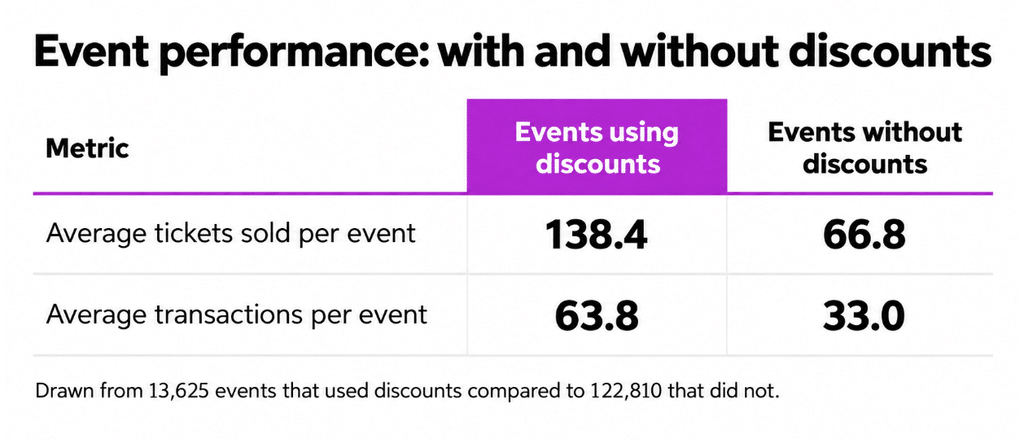
Here’s what we found from investigating more than 130,000 events on TicketLeap: Events that used discount codes sold 138 tickets on average, compared to 67 for events that did not. That is a 107.3% increase! That’s more than double! And the best part? Those extra tickets were mostly sold at full price.
Please keep in mind that these are averages across every kind of event on our platform, so your own results will vary based on your event type and the size of your audience.
Here's the surprising part: most of those extra tickets sold at full price
Ready for the plot twist? Your ticket promo code is not what is selling you more tickets.
At events that used ticket discount codes, only 16.3% of ticket sales actually redeemed a code. Roughly five out of six buyers paid the sticker price. So, the lift cannot be explained by "cheaper tickets sell better," because most of those tickets weren’t any lower in price.
Let’s dig a little deeper. Events using ticket discounts achieved 63.8 transactions on average, compared to 33.0 transactions for events with no discounts. That’s roughly double the number of separate buyers, rather than double the order size. The lift came from reaching more people.
The true driver behind this increase in ticket sales
So, what is really happening? Creating a ticket discount code gives you a reason to promote your events more, in a way that truly adds value. It is an excuse to launch another email campaign, a reason to make the post, and something concrete for your partners to share. It is shareable, trackable, and it gives someone a specific thing to say when they tell a friend. Organizers who build codes end up promoting more consistently, and that consistency is what doubles the sales.
Think about the difference. "Come to my show" is a favor you are asking for. "Here's $10 off with this code" is a gift you are giving. It’s the same message, but it carries a much different weight. So, the question worth asking is not, "Should I cut my ticket price?" The better question is, "How do I give people more reasons to talk about my event?"
Here's a special event pricing example:
Let’s crunch the numbers of how this works using an imaginary example. The Basement is a monthly stand up comedy night with 120 seats and $18 tickets. In a typical month, with a couple of social posts and no promo code, they sell 60 tickets. That is $1,080.
In November, they built one code, FRIENDS, for $3 off, and they promoted it heavily. This included an email to their list, two Instagram posts, and the code handed to the opening act to share with their followers. They sell 120 tickets, and 16% of those buyers use the code.
- 19 tickets at $15 (code used) = $285
- 101 tickets at $18 (full price) = $1,818
- Total: $2,103
The discount cost them $57 in ticket revenue, but in return, it brought in $1,023 in additional revenue. This was calculated by the $2,103 earnings with the campaign minus $1,080 in a typical month.
Most have yet to tap into the potential of this event ticket sales strategy
Want to know the interesting part? Only about 10% of TicketLeap events currently use ticket discount codes, which makes this a proven tactic that most have yet to try. If you have never run a ticket promo code, give it a try! You are sitting on the easiest lever most organizers don’t think to pull.
8 ticket sales promotional code ideas worth trying
Not sure where to start? Here are some event ticket promotion ideas to help you get the ball rolling.
1. The launch day ticket discounts
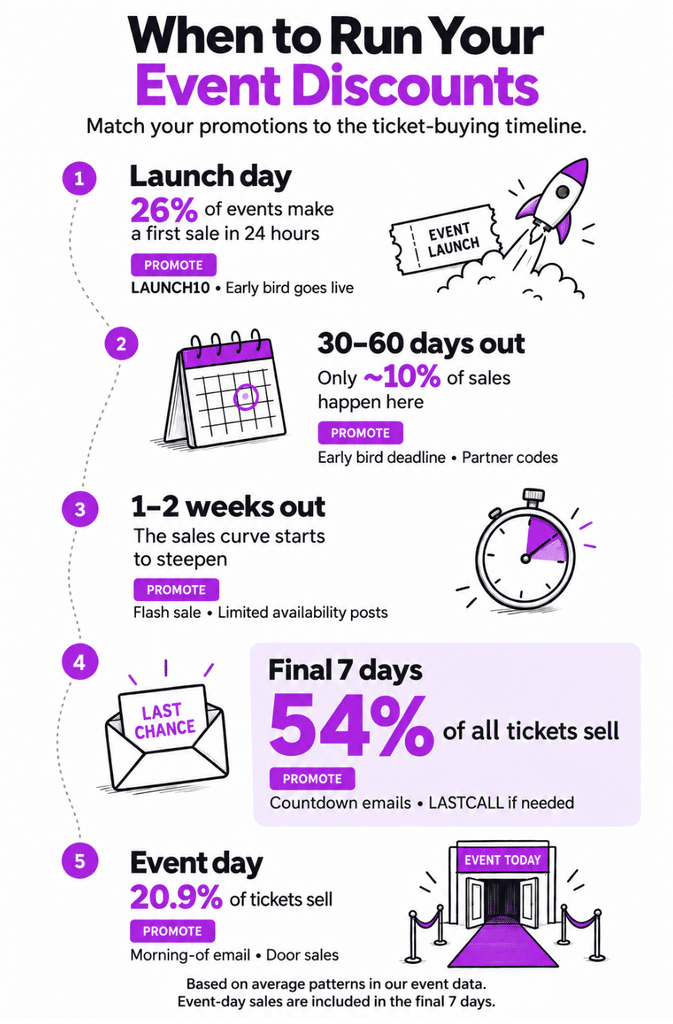
TicketLeap’s data shows that 26% of events make their first sale within 24 hours, so give your audience something to act on on that first day. The key is to make sure it expires within 2-3 days of launch, since that end date gives people a reason to buy today instead of bookmarking your page for later.
Code Example: LAUNCH10
- Setup: 10% off on the day your tickets go on sale and expires 72 hours after launch
- Messaging Idea: Tickets are live for Fright Farm 2026! The barn opens October 3, and this year the corn maze is twice as long. Use code LAUNCH10 for 10% off any night, good today through Sunday only. After that, we’re back to regular pricing. Grab your tickets now!
2. The share with a friend ticket promo code
The goal of this ticket discount code is to give your attendees an extra reason to invite their friends! This can be a percentage off or a flat dollar amount, posted publicly and built to be passed around. We recommend using flat dollar rates since they travel better than percentages. For instance, "$5 off" is much easier to tell someone how much money they’d be saving, rather than "12% off."
Code Example: FRIENDS
- Setup: Take off a flat dollar amount, have no expiration, and promote it as something to pass along.
- Messaging Idea: Bringing someone to our comedy club who has never been before? Use our code FRIENDS to take $3 off each ticket. Screenshot this and send it to the person you already know you are going to bring along!
3. The early bird promotion
Launched when your event first goes on sale, this can be a ticket discount code or a limited-time ticket tier! Price it notably below your regular admission price (e.g., $5-10 off) with a firm end date. It rewards your most loyal buyers and gives them more reason to buy now rather than wait. As you get closer to the deadline, share updates like "Only 12 early bird tickets left" or “Early bird pricing ends in 3 days!”.
Code Example: EARLYBIRD
- Setup: Cap this promo code one of two ways. Have a reduced price limited by quantity (e.g., for the first 15-25% of tickets sold), or limited by date (e.g., 3-6 weeks out from your onsale with a firm deadline).
- Messaging Idea: Get your tickets to our next conference at our early bird pricing while they last! They’re just $22 (compared to $30 general admission), limited to the first 50 tickets. This deal lasts through August 31.
4. The partner code
Hand two or three custom codes to local businesses, media contacts, and microinfluencers. Each one is trackable, so you learn which partner delivers. This is a powerful way to extend your event’s reach, because you are tapping into someone else's audience and bringing them value. For example, an annual nonprofit fundraiser dinner may share codes with the sponsoring bank, the local garden club, and food bloggers.
Code Example: PARTNER10
- Setup: Create a uniquely named code for each partner (e.g., LEXBREW10) for a certain amount off, with no expiration date. The naming convention will help you easily see in your reports who drove the sales.
- Messaging Idea (for sharing this code with a partner): Hi Maya, we're hosting the Harvest Gala on November 8 to raise money for the food bank, and I'd love to get it in front of the readers on your food blog for our local area. I set up a code just for your audience, MAYAEATS10, good for 10% off tickets to our gala. I've also attached a document with all our event’s essential info, including the link to the ticketing page. If it goes well, I'd love to do the same for our spring event!
5. The comeback code for past attendees
Send a personalized email with this discount code to someone who came last time and has not bought tickets yet for this year. This is the most receptive audience you will market to, and the discount code helps build your trust with this audience.
Code Example: WELCOMEBACK
- Setup: Export last year's attendee list, filter out anyone who has already bought tickets this year, and send a code to the remaining people on the list.
- Messaging Idea: You came to our haunted attraction last year, so here's first dibs! We're back October 3, and you're getting this before we announce it publicly. Use the code WELCOMEBACK for $6 off, good until next week.
6. The flash sale
This serves as a surprise, limited-time code that you deploy one to two weeks out to reach everyone still deciding. In your messaging, share any key numbers if your ticket sales are selling fast (e.g., "fewer than 50 general admission tickets left) and leverage this flash discount on the ticket tiers that need an extra boost. Always use your true numbers, because being transparent builds trust with your audience.
Code Example: FLASH8
- Setup: Set this discount to expire after 48 hours, and deploy in the 1-2 weeks before the final seven-day surge. Vary the timing so it lands as a genuine surprise.
- Messaging Idea: The seats to our next show are filling up fast! Use our code FLASH8 for $8 off, available for the next 48 hours (today at 10am until Thursday at 10am).
7. The final call code
Offer a larger discount of 25% off or so in a 48 hour window during the final week. This is a good tactic to keep in your back pocket for when sales could use an extra push. Use this one sparingly, since your sales should hopefully pick up in the final week on their own. As long as you continuously market your event, you may not need this one!
Code Example: LASTCALL
- Setup: Create a limited-time code for 25% off or more. Build it in advance and hold it until you are confident you need an extra boost with five to seven days to go.
- Messaging Idea: Our tickets are on sale for 25% off over the next 48 hours! Simply use the code LASTCALL at checkout. We only have 30 seats left and we’d love to see them full!
8. The key to unlock perks
Here is the idea for organizers who would rather hold their price steady. Use a discount code to unlock perks instead of cutting the price. Think free parking, a complimentary drink, a VIP upgrade, early entry. This allows you to have the same promotional buzz and shareability, but your ticket price stays exactly where you set it.
Code Example: FREEPARK
- Setup: Create a code that takes 100% off for the upgraded ticket tier and share it with the recipient(s) for the comp tickets. You could also have ticket bundles sold at a discount so it’s priced at your general admission cost, with the upgrades built in.
- Messaging Idea: For a limited time, get free parking at our event with your general admission ticket! Use the code FREEPARK on our GA + parking ticket bundle for $10 off to cover parking.
Beyond ticket discounts: Ways to create urgency without cutting price
Looking for other ways to level up your event ticket sales strategy without cutting the price? Here are a few extra ideas for you to try!
1. Limited quantity tiers
Stack Early Bird, then General Admission, then VIP. When your cheaper tier sells out, that is a credible signal to share with the public that your event is moving. Share how many tickets are left in certain tiers and announce when they’re sold out to build FOMO.
2. Expiring perks
Rather than dropping your price, attach a perk that expires. For example, the first 30 tickets may come with a free exclusive merch item or free parking by the front door. Look for perks that cost you very little and bring value to your attendees’ experience.
3. The waitlist
When a tier sells out, capture that demand instead of letting it drift. A waitlist gives you a list of eager buyers to email the moment you release more inventory, and it helps fill your next event before it is announced publicly.
4. Mark up at the door
Price your at the door tickets higher than online to drive earlier sales. For example, consider charging $25 online and $35 at the door, stated plainly on every post and flyer. Buyers get a $10 reason to commit early, and the organizer gets more data to work with from their online ticket buyers.
5. Group rates
A group tier for four or more drives bulk purchases and turns one buyer into an advocate. This allows perks for inviting more people, saving the attendees money and filling the venue with more people!
When to run each ticket promo code (based on when tickets actually sell)
Timing matters as much as the offer! Most guides tell you what to offer. Very few tell you when, because very few have a solid view of the sales curve like we do. Here is yours.
A few ground rules before you start
- Stick to your deadlines. Scarcity works best when it is real. Let your early bird discount expire right when you said it would, and your audience learns that your deadlines mean something. That credibility makes every future offer land harder.
- Lead with your event, then share the ticketing promo code. Your event is ultimately the value driver, so make it worth every dollar your attendees spend (whether full price or discounted). The code is the reason to act. Your event is the reason to care.
- Cap it. Make sure your ticket discount codes are for limited quantity and/or limited time. A capped offer is what creates the urgency.
- Track before you repeat. One code per channel tells you which ones work and which ones didn’t, so you know exactly what to keep next year.
- Do the math on your break even first. Calculate what your expected total costs will be and how much revenue you need to make to earn that back after your event. Determine what price and quantity is realistic for you to generate a profit, and then add a margin for discounted tickets.
Give people more reasons to buy
The bottom line is this: Events using discount codes often more than double their ticket sales (compared to those that don’t use them), and yet the codes themselves accounted for only 16% of their total purchases. What actually moved the needle on ticket sales was showing up consistently with something to say.
Lucky for you, TicketLeap is here to help! We have tons of features to empower your ticket sales, including unlimited discount codes, multiple ticket tiers, early bird pricing with an automatic end date, box office sales at the door, and reporting that shows you which ticket discount codes sold tickets.
If you’re looking for somewhere simple to start with, try adding an early bird tier and one flash sale to your next TicketLeap event. That only takes a few minutes to set up, and it covers both ends of your sales curve!
Frequently asked questions
Do discount codes increase event ticket sales?
TicketLeap’s data shows that events using discount codes sold an average of 138 tickets, compared to 67 for events without them. Only 16.3% of tickets sold for events using codes were purchased with a discount, meaning the vast majority still sold at full price. While this doesn’t prove discount codes caused the increase, their use was associated with higher ticket sales.
What ticket discounts should I offer for my event?
Ten percent is a reliable starting point for launch day and partner codes. Early bird tiers work well at $5 to $10 below general admission. Save deeper discounts, around 20% to 25%, for a short final week push, and always attach a clear end date.
When should I release an early bird ticket?
Make it live the day your tickets go on sale and close it roughly 30 days before your event. That covers the quiet 30 to 60 day stretch where only about 10% of sales happen, and it gives your most enthusiastic buyers a reason to move early.
How many discount codes should one event run?
Three to five is a comfortable range: a launch code, a shareable code, two or three partner codes, and a last call code held in reserve. Give each one a distinct name so your reporting shows you which channel earned the sale.
- Events that use ticket discount codes sell more than twice as many tickets
- 8 ticket sales promotional code ideas worth trying
- Beyond ticket discounts: Ways to create urgency without cutting price
- When to run each ticket promo code (based on when tickets actually sell)
- A few ground rules before you start
- Give people more reasons to buy
- Frequently asked questions
Data-Driven Marketing Playbook

Stay Ahead With Our Latest Event Articles Delivered Straight to Your Inbox
Subscribe today to elevate your event planning game!
Receive exclusive insider tips on how to:
- Plan a successful event
- Maximize your ticket sales
- Optimize your marketing campaigns
- Ensure your event day runs smoothly